
Poly Pocket
The spread is tight. The morals are looser.


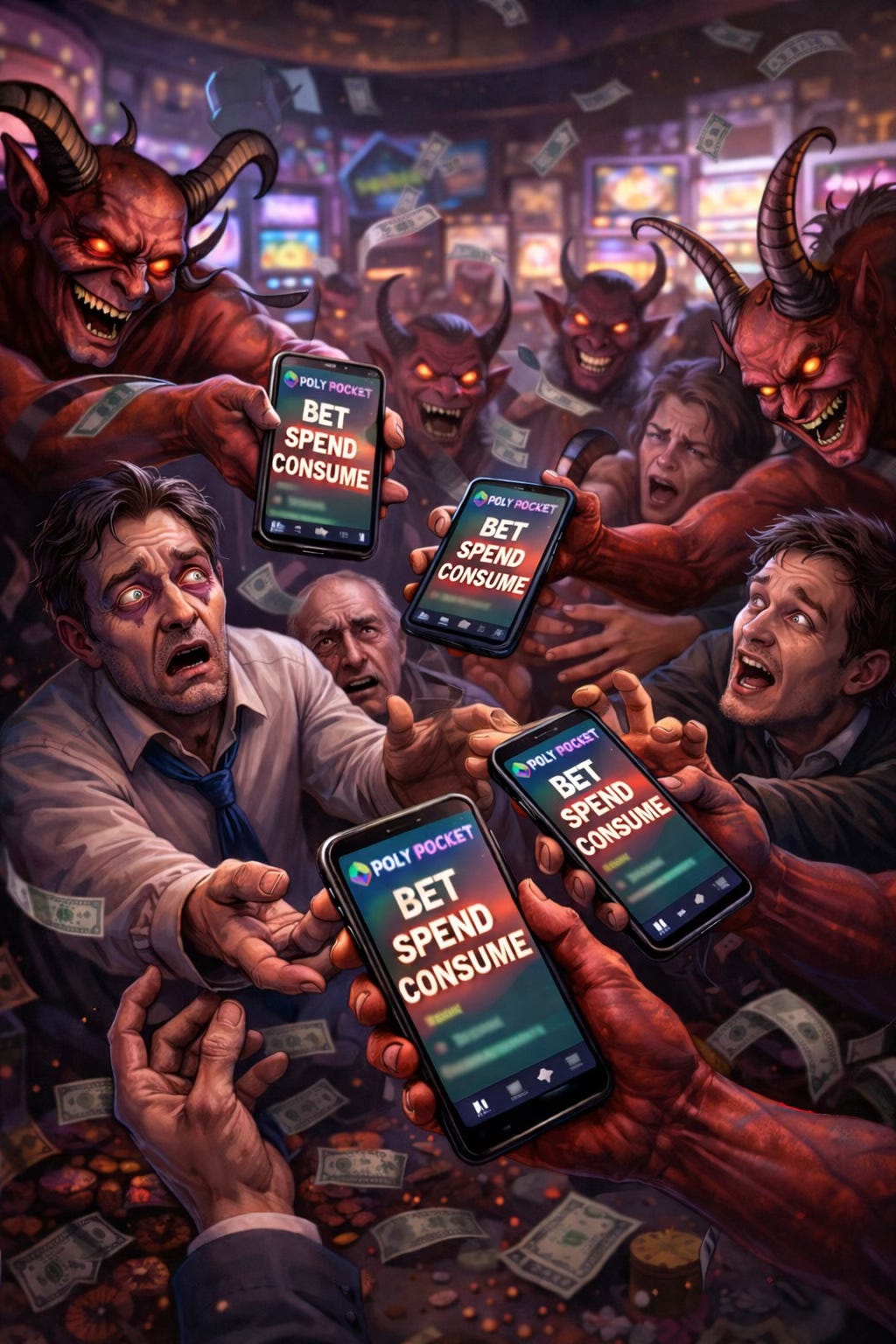
I know I’m beating a dead horse over here and I’ve covered about this topic a few times already but I need to keep fighting. I hate the normalization of gambling to society and most importantly to children. I hate to sound like a conspiracy theory guy but I’m starting to think that the people in Big Tech and Wall Street don’t have our best interests in mind.
There used to be a wall between sports and gambling.
Now the wall is plastered with a promo code.
What started as a few commercials has turned into full integration. Odds crawl across the bottom of broadcasts. Analysts reference spreads mid-sentence. Pregame shows are “presented by” sportsbooks. Arena signage rotates between insurance companies and betting apps.
This isn’t subtle anymore.
It’s infrastructure.
DraftKings and FanDuel logos glow inside professional arenas. Prediction platforms like Kalshi and Polymarket turn real-world events into tradable contracts.
We didn’t just legalize gambling.
We normalized it.
The Broadcast Is the Casino
Watch a game today and count how many times you see betting references:
Live odds graphics
Sponsored “same-game parlay” segments
Halftime analysis tied to spreads
Push notifications before tipoff
Sports media used to debate matchups.
Now it debates lines.
The line between analyst and affiliate marketer is paper thin.
And the message isn’t “be careful.”
It’s “download now.”
The Athlete as Endorsement
We’ve moved beyond league sponsorships. Now players themselves are stepping into the ecosystem.
When a global superstar like Giannis Antetokounmpo partners with Kalshi, that isn’t just marketing.
It’s cultural validation.
It tells fans — especially young ones — that this is modern, smart, forward-thinking.
It moves gambling from vice to lifestyle.
And that shift matters.
Giannis is now the Greek God of gambling.
Pete Rose Is Rolling Over
Once upon a time, Pete Rose was banished from baseball for gambling on games.
Now sportsbooks sponsor broadcasts. Odds are integrated into league data feeds. Prediction markets sit courtside.
The same sports world that once treated gambling as a mortal sin now treats it as a growth strategy.
You almost have to admire the pivot.
Pete Rose is probably rolling over in his grave right now.
The Stats Nobody Puts in the Commercial
The ads show the winner. The fist pump. The $25 turning into $140.
They don’t show this:
Around 1–3% of U.S. adults meet criteria for severe gambling disorder.
Another 2–4% experience moderate gambling problems.
Gambling disorder is associated with higher rates of depression, anxiety, and substance abuse.
Studies consistently show one of the highest suicide attempt rates among behavioral addictions.
Problem gamblers are significantly more likely to experience high-interest debt, bankruptcy, and financial instability.
And that was before sports betting became frictionless and mobile.
Now the casino lives in your pocket.
No drive.
No line.
No social friction.
Just tap. Confirm. Repeat.
The Financialization of Fandom
This is the bigger shift.
A missed free throw isn’t just a mistake — it’s a spread swing.
A garbage-time touchdown isn’t meaningless — it’s a parlay breaker.
A rookie injury isn’t tragic — it’s a market adjustment.
Athletes become variables.
Games become volatility events.
Fans become traders.
And the leagues?
They collect the sponsorship checks.
The Youth Exposure Problem
This is what bothers me the most.
Teenagers and even pre-teens grow up hearing betting terminology during nationally televised games. They see influencers posting slips. They watch athletes align with prediction platforms.
By the time they’re legally allowed to gamble, it doesn’t feel risky.
It feels normal.
When gambling is:
Broadcast-integrated
Athlete-endorsed
Algorithmically optimized
Socially rewarded
The cultural barrier disappears.
And normalization is the most powerful marketing tool of all.
The Mental Health Cost
Problem gambling isn’t loud.
It’s quiet.
It looks like:
Refreshing odds at 1:13 a.m.
Chasing losses after “almost” hitting
Hiding transactions
Anxiety spiking during garbage time
Frequent bettors are more likely to report financial stress and revolving debt. Gambling disorder correlates strongly with depression and insomnia. The shame keeps it hidden. The apps keep it easy.
You’re not “in trouble.”
You’re “just having a bad week.”
Until you’re not.
Final Odds
Will betting apps and prediction markets keep embedding themselves into professional sports?
Revenue incentives: Massive
Cultural resistance: Weak
Youth exposure: Accelerating
Long-term mental health cost: Underestimated
I don’t think this is some shadowy smoke-filled room conspiracy.
I think it’s simpler.
Wall Street loves recurring revenue.
Big Tech loves engagement loops.
Leagues love sponsorship money.
And nobody wants to be the adult in the room saying maybe we shouldn’t turn every game into a gambling interface.
We used to pretend gambling and sports needed distance.
Now the house has naming rights.
And the house always scales.
 | A guest post by
|